


Take a moment. Think about how your company or nonprofit currently creates content. What does that process look like?
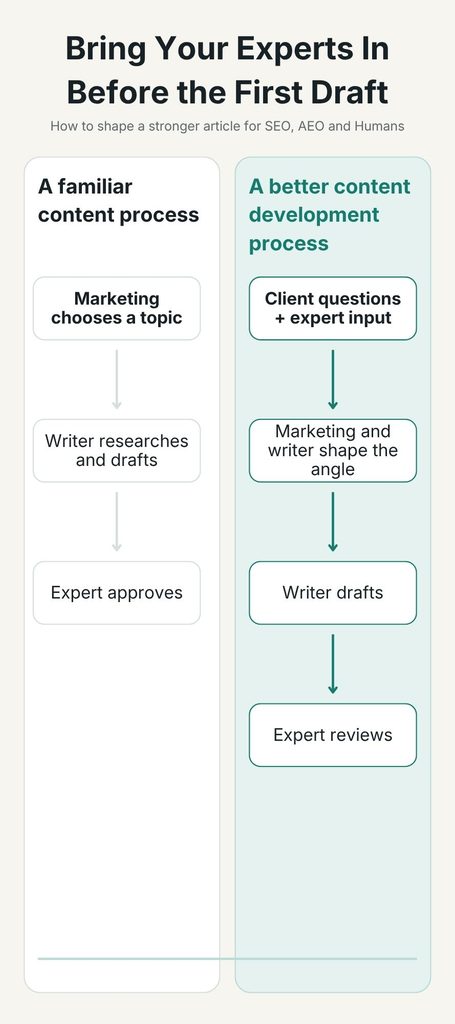
For many organizations, that looks like: the marketing team comes up with an idea, hands it to a writer and then it goes back to leadership for approval.
Does this sound familiar to you?
If so, you’re missing a pretty important part of the process, especially as AI search optimization takes center stage in digital content planning.
As you plan your 2027 B2B content strategy, think about when your subject-matter experts get involved. Are they helping shape the article before the writing begins? Or are they seeing it for the first time when someone needs their approval?
That timing matters. The people who work with your clients have knowledge, experience and key opinions that should help guide what you publish. And your SEOs and content writers need their insights ASAP.
Key Takeaways
- Bring your experts into the process before writing begins. Their input should shape the topics, examples and advice.
- Use client questions to guide content planning. Your sales and client service teams hear what buyers actually want to know.
- Make participation manageable. Focused questionnaires and short interviews give busy experts a practical way to contribute.
- Build content around firsthand knowledge. Specific experiences give readers something useful beyond information they can find elsewhere.
Why should your subject-matter experts help shape your content strategy?
Subject-matter experts help your content reflect what your organization actually knows from working with clients.
I’ve worked with companies that want to publish more content but don’t necessarily have much time to provide input. Basically, they want a writer to research a topic, write the article and send it over for review. Bada-bing bada-boom, limited SME involvement.
And I totally understand why—everyone’s busy!
Plus, getting content published regularly can be challenging even before an article crosse the desk for expert approval.
But your SEO writer can only work with the information available to them.
- Your writer can research a topic.
- Your SEO consultant can identify relevant keywords and AI queries.
- Your marketing team can manage the content calendar.
But, your experts bring the experience that makes those efforts successful for search engines. Content without unique perspectives often bores readers and is rarely citable by AI or Google.
Think about an accounting firm’s partners or the leadership team at an executive search company. They know where clients get stuck, what prospective clients misunderstand and which questions keep coming up in call after call.
That’s information your marketing team needs. Heck, that’s what your next prospect wants to read (and ChatGPT wants to recommend.)
How can client conversations help you choose better content topics?
Client conversations reveal the questions, concerns and decisions your content should address.
Keyword research is a useful starting point for a B2B content marketing strategy. It helps you understand the language people use and where demand may be. Through my SEO consulting work, I help companies identify what their audience is searching for and where there may be opportunities for useful content.
But, the content goldmine is what’s happening in your conversations.
- What do prospective clients ask before they’re ready to move forward?
- What does your team find itself explaining over and over?
- What do clients wish they had understood earlier?
- What are myths that you bust?
- Who are the competitors your prospects complain about?
Those questions can lead to articles with a clear purpose.
For example, “What should we have ready before an audit?” gives an accounting firm a specific question to answer. A partner can explain what clients tend to overlook, why it matters and how to prepare.
Now your content has practical advice behind it.
When should leadership get involved in content creation?
Leadership should contribute as the topic and angle develop, make time to share their expertise and review the draft for accuracy. If the first time an C-Suite sees an article is during final approval, you may discover that the most useful idea is missing. Or the direction of the topic is completely off base.
Getting that input earlier gives the writer a clearer direction. It also gives leadership a chance to explain what they want readers to understand.
But all of this this takes a willingness to participate. Someone has to answer the questions, make time for a conversation and provide thoughtful feedback. Your marketing team can make the process easier, but leadership needs to follow through.
I think this is where expectations sometimes get disconnected.
Organizations want content that demonstrates their expertise and brings in new opportunities, but the people with that expertise aren’t always available to contribute.
Without their involvement, the content may not hit right with a prospect or sound any different from similar ranking content out there.
Content creation is a collaboration. Your writer and content team brings the ability to ask questions, organize ideas and communicate clearly. Your experts bring the experience and perspective that make the content your own. Both need to make time for the process.
How do you involve busy leaders without making this another big project?
Give your leaders a focused, manageable way to share what they know.
I use quarterly questionnaires and expert interviews to gather input for content planning and writing. The goal is to ask questions that make it easier for someone to give a useful answer.
“Do you have any blog ideas?” puts a lot of work on the person receiving it.
Try asking:
- What question have clients asked you recently?
- What do people often get wrong about this topic?
- What would you tell a client who was dealing with this situation?
Your subject matter expert doesn’t need to write the article. A writer can organize their answers, ask follow-up questions and turn that input into something clear and useful.
What role should AI play in expert-led content?
AI can support planning, drafting and editing, while your experts supply the firsthand knowledge and judgment.
Keep key takeaways easy to find. Use headings that reflect real questions, and answer those questions directly before expanding on them.
As you build your 2027 B2B content strategy, make time for the people whose expertise you’re trying to communicate. Ask them better questions. Bring them into the conversation earlier. Give your writer something meaningful to work with.
Does your SEO strategy reflect what your team knows?
I work with B2B companies on SEO and AI visibility strategy, including how their content can better communicate their expertise and answer prospective clients’ questions.
If you’re planning for 2027, let’s talk about how your team’s knowledge can support that strategy.